



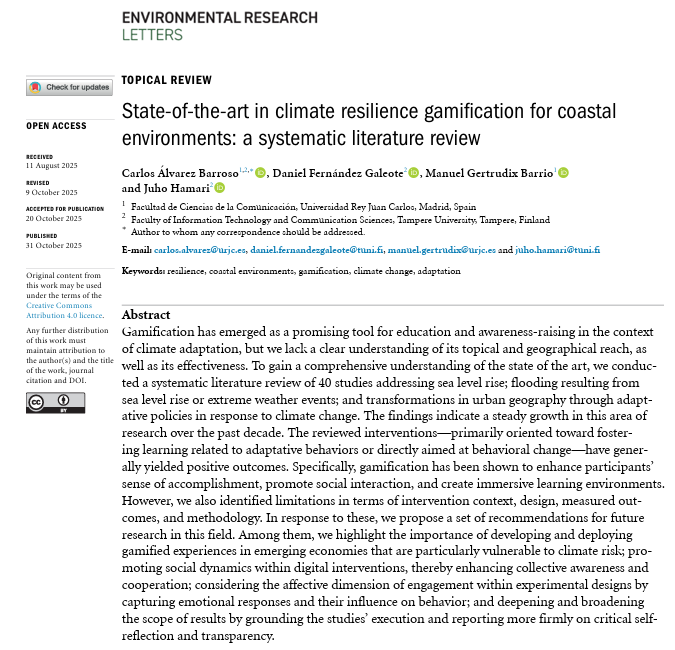
State-of-the-art in climate resilience gamification for coastal environments: a systematic literature review
Initial approach and objectives of the study
The study stems from the need to systematize and analyze existing empirical evidence on the use of gamification and serious games as tools to promote climate resilience in coastal urban environments. Given rising sea levels and the impacts of climate change on coastal areas, the authors recognize that games can serve as platforms for learning and social engagement, enabling communities to understand risks and adopt adaptive practices. The work is part of a systematic literature review approach and seeks to recover empirical research that evaluates gamified interventions related to climate adaptation, identifying trends, gaps, and good practices. The objective is to synthesize and analyze the empirical results of gamified experiences designed to promote participation and engagement with climate resilience in urban coastal environments, providing guidelines and design alternatives for future research.
Methodology and tools used
The methodology is based on the guidelines of: PRISMA 2020 (Page et al., 2021); DESLOCIS (2021) and the analytical tools used in Fernández Galeote et al (2021).
How was the data collected?
Data collection was carried out through a systematic review of the literature following the phases outlined by Okoli (2015) and the PRISMA 2020 guidelines. Publish or Perish software was used to search for studies in the Scopus and Web of Science databases, applying a chain of terms related to gamification, climate resilience and coastal environments. The data were extracted manually using a coding template based on the DESLOCIS model and the analytical tools used in Fernández Galeote et al (2021), which allowed variables on context, game design, population and results to be organized.
What type of analysis was carried out?
In the quantitative part, a descriptive and comparative analysis of the data extracted from the 40 studies reviewed was applied, using frequencies, percentages and distributions (by year, country, type of game, population, and results). What results did you obtain and why are they important? The results suggest three possible future scenarios. To achieve the desired scenario and avoid the dystopian one, recommendations for practical application in the field of education are proposed. In the qualitative part, a thematic and categorical analysis was carried out, examining the dimensions of engagement (cognitive, affective, behavioral, and experiential) and the characteristics of game design. This analysis allowed us to identify patterns, good practices, and methodological limitations. Finally, the authors integrated both approaches to classify the studies according to their quality and methodological strength and to formulate recommendations for future research based on the synthesized evidence.
Based on the study’s conclusions, what are the future applications of the
research results?
The study’s findings can be applied to the design of educational and environmental communication programs that use gamification to promote climate resilience and adaptation in coastal communities. They also pave the way for new research and projects in vulnerable contexts, incorporating social and emotional dimensions that promote cooperation and behavioral change in the face of climate change.
Full bibliographic reference
Álvarez Barroso, C., Fernández Galeote, D., Gértrudix Barrio, M & Hamari, J. (2025). State-of- the-Art in Climate Resilience Gamification for Coastal Environments: A Systematic Literature Review. Environmental Research Letters, 20, 113007. https://doi.org/10.1088/1748-9326/ae151d.
Research group(s) (institutions or centers to which the researchers who participated in the study belong)
Ciberimaginario Research Group:
Carlos Álvarez Barroso, Madrid (Spain) Rey Juan Carlos University
Manuel Gértrudix-Barrio, Madrid (Spain) Rey Juan Carlos University
Gamification Group:
Daniel Fernández Galeote, Tampere (Finland) University of Tampere
Juho Hamari Tampere (Finland) University of Tampere
Research project (within which work the study is included)
eCOMCIENCIA New interactive and immersive narratives to promote the circular economy and social innovation through scientific communication and citizen science from the School (PID2021-127019OB-I00)
Sorry, the comment form is closed at this time.