RGB ReSTIR: Per-Channel Reuse - Method for Asymptotically Noise-Free ReSTIR
2025, Haikio, S., Master of Science thesis, Tampere University.
Abstract: In computer graphics, photorealistic rendering requires the evaluation of difficult integrals. The methods to approximate these integral calculations are usually a compromise between computational cost and approximation quality. The ReSTIR algorithm developed in recent years has offered efficient integral calculations with low cost by reusing the calculation between temporal and spatial pixels. This idea is based on Monte Carlo integral methods and resampling. For the resampling, the ReSTIR typically uses a relative color luminance as a target function. This target function is used to approximate the real integral value.
One problem of the ReSTIR is that the target function is a single-channel function, and the output is RGB-color value. To reach the best quality, the target function should be proportional to the output value. Sometimes this is not possible because the relative color luminance target function cannot fulfill the proportionality for every color channel. If this is the case, the ReSTIR algorithm cannot be noise-free.
This thesis proposes a method to multiply ReSTIR for RGB color channels. This method is called RGB ReSTIR. Instead of using the color luminance as the target function, RGB ReSTIR uses the real value of the color channel for resampling. This method allows the target function to always be proportional for every color channel, which makes this method asymptotically noise-free. This method also provides less color noise for scenes with multicolored lighting.
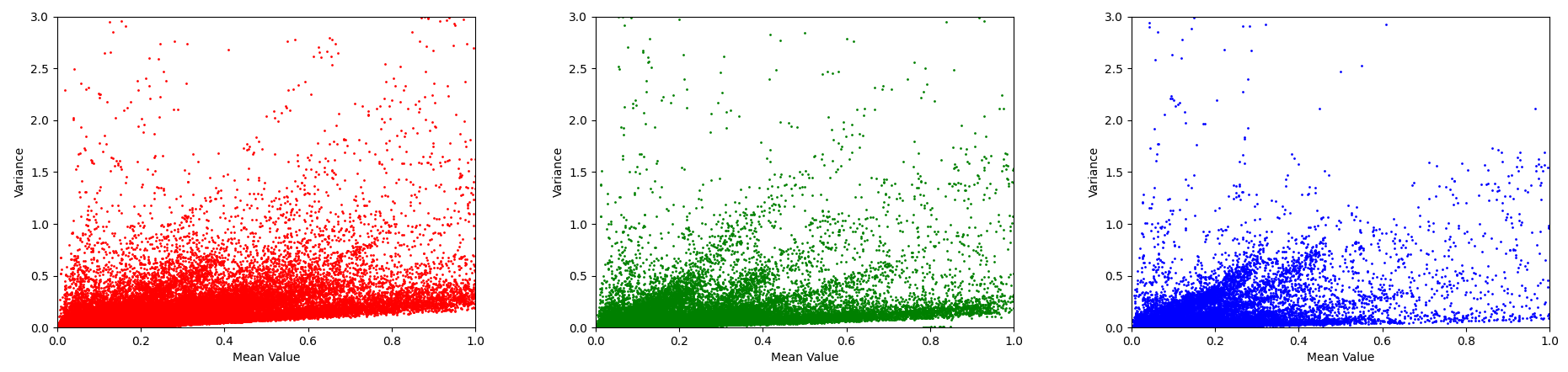
In this thesis, the RGB ReSTIR is tested in scenes with different lighting properties. Even if the RGB ReSTIR provides less color noise in multicolored scenes compared to the luminance-based ReSTIR, the total noise measured by PSNR is not much better. In addition, plotting the relation between the mean value and the variance reveals that the relationship of the mean and variance does not differ significantly from the luminance-based ReSTIR. RGB ReSTIR also struggles with white light by removing the connection of noise between channels. This means that every channel has unique noise that can be seen as color noise. Based on the result of this thesis, the quality benefits of the RGB ReSTIR are confined mostly to the visual quality of the color noise for multicolored lighting scenes