Scalable Hole-Filling for Real-Time Multi-GPU Light Field Path Tracing
2026, Leria, E., Mäkitalo, M., Jääskeläinen, P. and Sjöström. M, In IEEE Transactions on Visualization and Computer Graphics (TVCG).
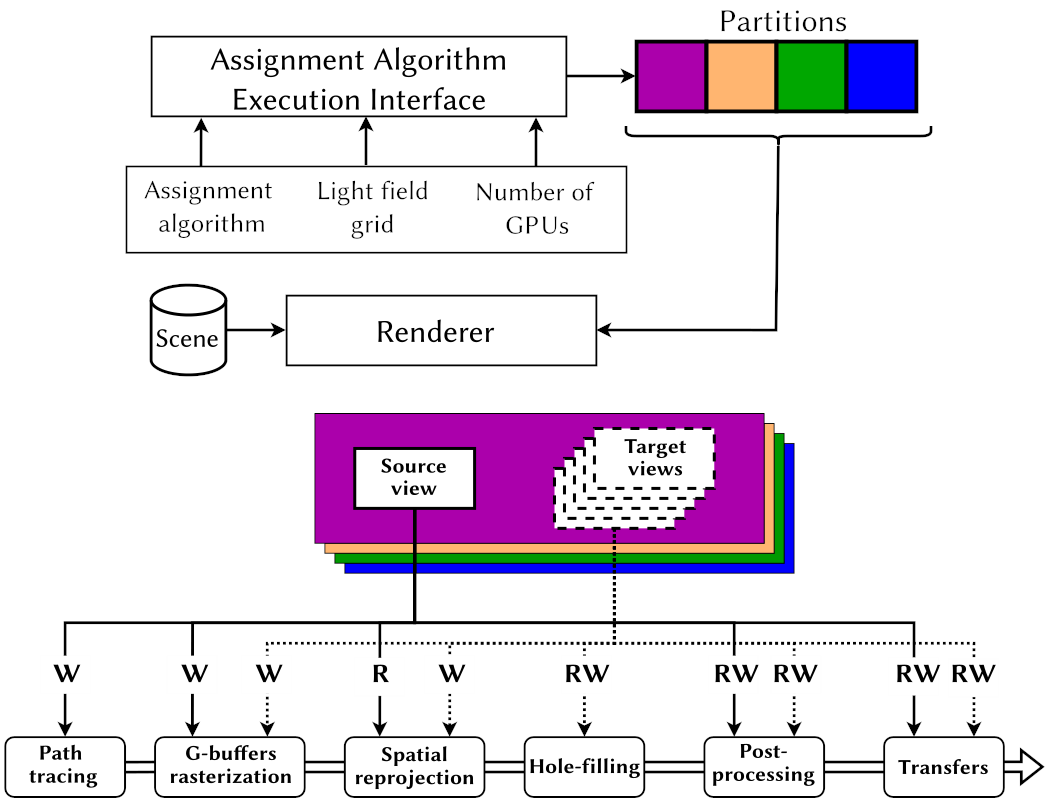
Abstract: Light field (LF) displays address the mismatch in focus cues present in traditional displays by triggering natural defocus blur and enabling motion parallax. They rely on geometrical optics, displaying rays from multiple angles of view. LF path tracing is computationally expensive for real-time applications, since it requires rendering multiple views. To reduce this computational complexity, spatially reprojecting pixels between views is commonly performed. Reusing pixels that are already rendered is cheaper than path tracing additional ones. However, when occluded areas are uncovered in some views, reprojection is not possible, creating holes in these views. Filling-in the holes requires extra path tracing computation. This paper investigates scalable hole-filling strategies for LF path tracing, using multiple GPUs to reach real-time performance. We propose an algorithm search optimization procedure to determine whether a specific assignment algorithm can be generalized across scenes, using the hole-filling time as a minimization function. In addition, we introduce DaSH (Discarded and Subsampled path traced Hole-filling), a novel method that reduces computation and divergence overhead in fixed-size hardware thread-blocks. Based on local pixel sparsity within pixel patches, DaSH adaptively subsamples and discards hole-filling rays. Our evaluation demonstrates that DaSH achieves significant performance gains while preserving the visual and structural quality of refocused light field images at the retina plane. The experiments demonstrate an average speedup factor of 1.8x for DaSH, compared to prior work, in a multi-GPU rendering system.